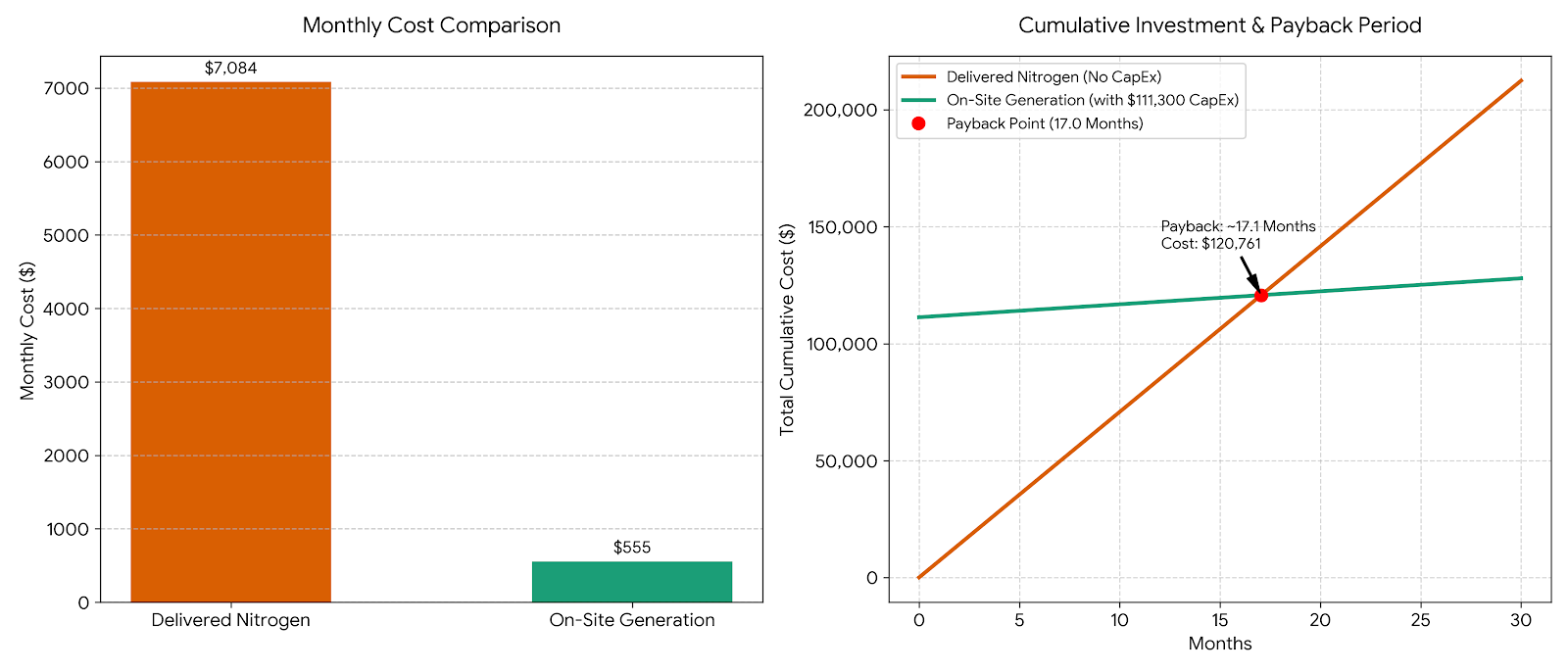
ROI Example & Payback
Example Cost Savings (99.95% Purity, includes tank rental and delivery fees):
(1 gallon of liquid nitrogen ≈ 93–94 SCF of gas)
A facility using 6,585 gallons of liquid nitrogen per month (≈616,000 SCF) at a fully loaded cost of $1.15 per 100 SCF spends approximately $7,084 per month on delivered nitrogen.
With a Comairco-specified on-site nitrogen generation system operating at $0.09 per 100 SCF, those monthly costs drop to approximately $555 per month.
Monthly Savings: $6,529
Annual Savings: $78,348
Estimated Payback: A $111,300 system would pay for itself in approximately 17–18 months.
What is Nitrogen Generation?
Nitrogen generation is the on-site production of nitrogen gas from ambient air, eliminating the need for delivered high‑pressure cylinders or bulk liquid nitrogen. Because air is composed of approximately 78% nitrogen, generation systems separate nitrogen from oxygen and other gases to produce an inert gas at the required purity level. This process provides a reliable, continuous nitrogen supply for industrial operations throughout the Northeast United States.
Nitrogen is widely used because it is inert and non-reactive, dry with very low moisture content, non-flammable, and highly effective at displacing oxygen. These properties make it ideal for maintaining stable, controlled environments in manufacturing, processing, and energy applications.
Why Industries in the Northeast Use Nitrogen
Across New York, Pennsylvania, and the Northeast region, nitrogen plays a critical role in improving safety, product quality, and operational reliability. It is commonly used to:
Prevent oxidation of products and materials
Reduce fire and explosion risks
Create oxygen‑free or moisture‑free environments
Protect sensitive equipment and industrial processes
Common Industrial Applications
Tank blanketing and inerting (chemical processing)
Vessel and pipeline purging
Food and beverage packaging (MAP systems)
Laser cutting and fabrication shops
Electronics and semiconductor manufacturing
Pharmaceutical and biotech production
On-Site Nitrogen Generator Cost Structure
On‑site nitrogen generation systems, whether PSA or membrane-based, convert compressed air into usable nitrogen, making operating costs primarily dependent on the compressed air system efficiency. The largest contributor is typically electricity consumption, followed by routine maintenance requirements such as replacing filters, valves, and carbon molecular sieve (CMS) media. Overall system efficiency—especially the performance of the air compressor—also plays a significant role in determining operating cost, along with the required nitrogen purity level, as higher purities generally demand more energy and tighter system operation.
How On‑Site Nitrogen Generation Works (PSA Systems)
Pressure Swing Adsorption (PSA) – Most Common Industrial Method
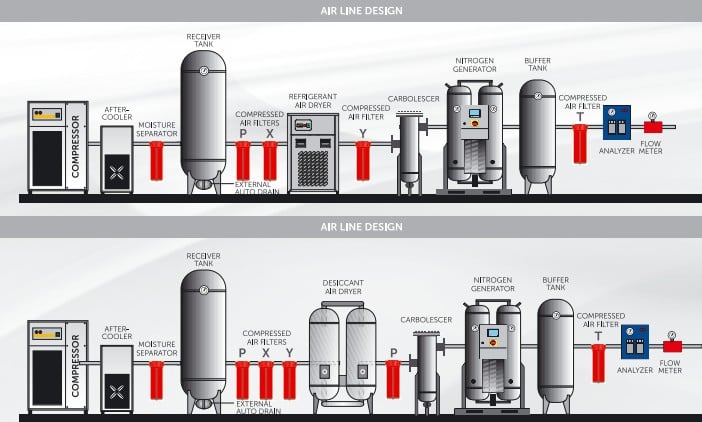
Pressure Swing Adsorption (PSA) is the most widely used method for industrial nitrogen generation. The Nitrogen Generator consists of two adsorber vessels filled with CMS (Carbon Molecular Sieve). Clean and dry air is directed to one of the adsorber beds where oxygen and water vapor are adsorbed faster than nitrogen in the pore structure of the CMS, resulting in increased nitrogen purity of the product gas stream to the desired level, producing nitrogen at purities ranging from 95% up to 99.999%.
PSA systems are ideal for:
Manufacturing plants with variable demand
High-purity applications
Continuous process operations
For facilities across Comairco’s service territory, PSA systems provide a reliable alternative to bulk nitrogen delivery with significantly lower long-term operating costs.
Nitrogen Generator Cost per SCF (Operating Cost Breakdown)
Nitrogen Cost per 100 SCF (On-Site Generation)
Nitrogen Purity | Cost per 100 SCF |
~97% N₂ | ≈ $0.05 per 100 ft³ |
~99.5% N₂ | $0.10–$0.14 per 100 ft³ |
High purity (>99.9%) | Higher, but still far below delivered gas |
Traditional Liquid Nitrogen Supply | ||
|---|---|---|
Supply Medium | Demand Scale | Cost per 100 SCF |
Cylinders | Small demand (300 ft³ per cylinder) | $5.00 or more per 100 ft³ |
Dewars | Mid-size demand (2,000–5,000 ft³) | $1.50 or more per 100 ft³ |
Bulk Liquid | Large demand (400–12,000 gallons) | $.65-$1.00 per 100 ft³ |
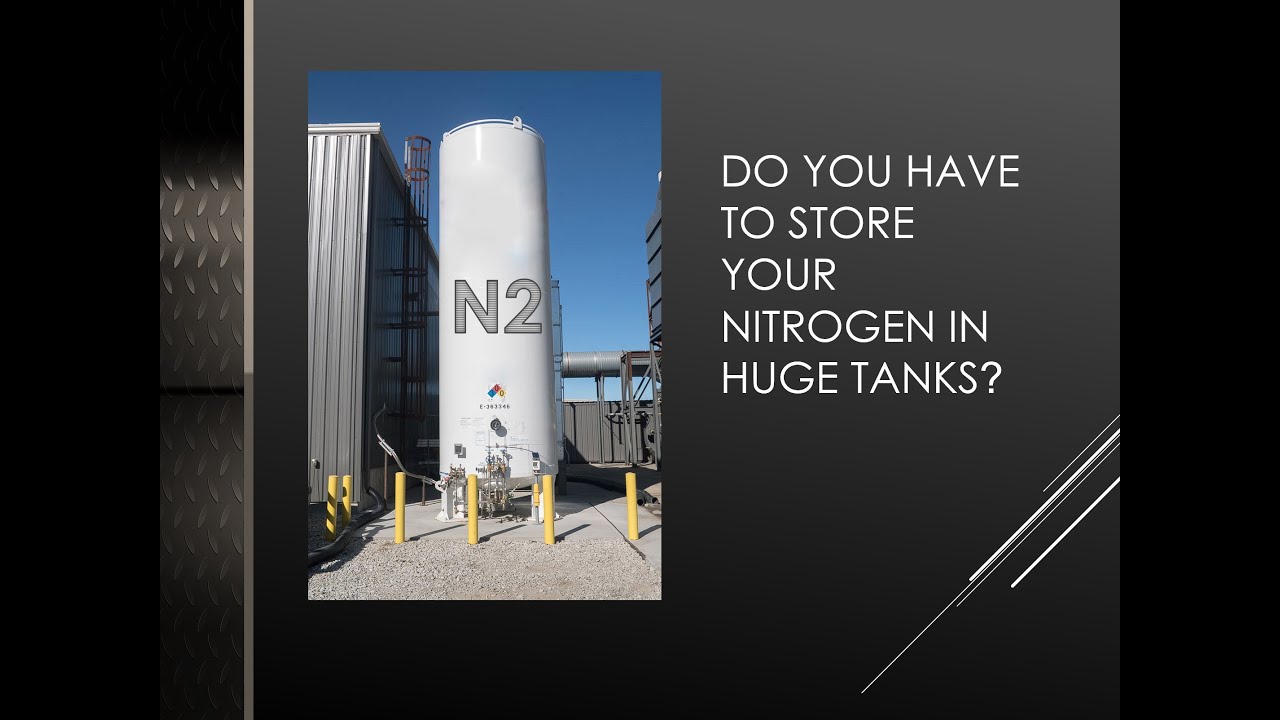
Liquid Nitrogen Supply Hidden Costs
Tank Rental Fee: As much as $2,500 per month
Delivery Charges: $25.00 - 75.00 per delivery (multiple deliveries per order possible)
Environmental Surcharge: $35.00 per delivery
Boil Off: A percentage of N2 vents to atmosphere
Annual Price Increases: 10%-15% annually
Long term Contracts: 3–10-year commitment
"Evergreen Contract": 12-month notice to cancel - Automatically renews
Adds: $.10-$.15 per 100 ft³

Nitrogen Generator CAPEX (Installed Cost)
The capital cost of a nitrogen generation system depends on flow, purity, and system configuration.
Typical Installed Cost Ranges | |
|---|---|
System Size | Installed Cost (USD) |
Small / Lab | $5,000 – $25,000 |
Mid‑Range Industrial | $25,000 – $100,000 |
Large Industrial | $100,000 – $400,000+ |
Factors affecting cost include:
Industries We Serve Across the Northeast
Comairco supports nitrogen generation applications across:
Manufacturing and fabrication plants
Food and beverage processing facilities
Breweries and packaging operations
Automotive and tire inflation systems
Chemical and petrochemical plants
Power generation and utilities
Why Choose Comairco for Nitrogen Generation?
Not sure if nitrogen generation makes sense for your facility?
Comairco can evaluate your current nitrogen usage and show you:
Your actual cost per SCF
Projected savings with on‑site generation
Recommended system size and ROI timeline
Get a Free Nitrogen Generator Cost Analysis
or
Schedule a Site Visit with a Comairco Specialist
Phone: 1-877-NEED AIR
Frequently Asked Questions About Nitrogen Generation
Is On-Site nitrogen cheaper than delivered nitrogen?
Yes. Most facilities reduce cost by 40–80% because they avoid delivery, rental fees, and supplier markups.
What purity can PSA nitrogen systems achieve?
Typically, 95% to 99.999% depending on configuration.
How much does a nitrogen generator cost?
Nitrogen generator capital costs vary widely based on size, purity, pressure, and configuration, with small laboratory or low-flow units ranging from $3,000 to $35,000. For moderate industrial operations, mid-range systems with advanced filtration and automation typically fall between $25,000 and $100,000. Large-scale industrial systems requiring high-pressure boosters or ultra-high purity levels (99.9% to 99.999%) can exceed $500,000. Beyond system size, final upfront pricing is heavily influenced by customization needs, turnkey integration, and component grades, though these investments are offset by the long-term operational savings of eliminating delivered gas.
What size nitrogen generator do I need?
Start by determining your nitrogen demand by analyzing how much nitrogen your operation uses, including volume per cycle, frequency, and total operating hours. Next, define the required purity level, as applications range from lower purities (95–99.5%) for general use to ultra-high purity (up to 99.999%) for industries like pharmaceuticals and laser cutting. Finally, calculate the necessary flow rate—typically measured in CFM or LPM—by evaluating how many processes run at once and your peak demand, ensuring the system can meet your needs without interruption. Let us help you determine the size you need.
Is nitrogen generation safe?
Nitrogen generation is safe when systems are properly installed and maintained, but it does present some hazards that must be managed. Because nitrogen displaces oxygen, it can create asphyxiation risks in confined spaces, while liquid nitrogen can cause severe cold burns due to its extremely low temperature. Additional risks include pressure build‑up from rapid gas expansion, potential high‑pressure leaks, and oxygen imbalance in certain processes, all of which require proper system design and safety controls.
What affects nitrogen generator efficiency?
Nitrogen generator efficiency is influenced by operating conditions, system design, and air quality. Key factors include maintaining stable temperatures, ensuring clean and dry compressed air, and optimizing pressure, flow rate, and air-to-nitrogen ratios to minimize energy use. Proper system sizing, along with routine maintenance of filters and components, is essential to sustain performance, improve purity, and extend equipment life.
How long is the payback period?
Can be as fast as 6–24 months
Phone: 1-877-NEED AIR




© 2026 Comairco Equipment Inc. All rights reserved.